The right SCBA compressor size is not determined by the size of the fire department alone. It depends on the pressure and capacity of the SCBA cylinders, the number of cylinders that must be filled during the busiest hour, total daily filling demand, available power, and whether the department uses direct filling or cascade storage.
To determine what size SCBA compressor a fire department needs, start with peak filling demand rather than average daily use. A system that handles normal training fills may still be undersized when several cylinders must be refilled immediately after an emergency response.
Quick answer: A smaller department with moderate demand may be well served by a standard stationary compressor. Departments that fill cylinders in batches, operate a cascade system, need faster turnaround, or require backup capacity may need a higher-output or dual-compressor system.
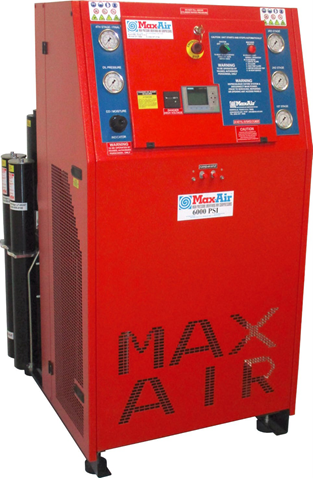
For departments evaluating a 6000 PSI system with a vertical cabinet configuration, the Max-Air MA90 VRT 6K provides 10.8 SCFM charging capacity for SCBA cylinder filling and cascade-system replenishment.
How to Determine What Size SCBA Compressor Your Department Needs
Before comparing compressor models, collect the following information:
- SCBA cylinder pressure and capacity
- Maximum cylinders filled during the busiest hour
- Total cylinders filled during a typical day
- Direct-fill or cascade-storage requirements
- Available electrical phase and voltage
- Desired fill time and future growth
These factors determine the pressure, airflow, storage capacity, electrical requirements, and overall configuration of the breathing-air system.
1. Identify Your SCBA Cylinder Size and Pressure
The first step is identifying the cylinders your department fills most often. Common 4,500 psi fire-service cylinder profiles include:
- 30-minute SCBA cylinder: approximately 45 cubic feet
- 45-minute SCBA cylinder: approximately 66 cubic feet
- 60-minute SCBA cylinder: approximately 88 cubic feet
A larger cylinder requires more compressed air and generally takes longer to fill than a smaller cylinder when using the same compressor. Starting pressure also matters. Refilling a partially depleted cylinder requires less compressor output than filling an empty or nearly empty cylinder.
Confirm the cylinder manufacturer’s working pressure and valve connection before selecting a compressor, fill hose, storage system, or containment fill station.
2. Size the Compressor for Peak-Hour Demand
One of the most common sizing mistakes is using only the department’s average daily cylinder count.
For example, a department may fill only eight cylinders during a normal day. However, if all eight must be refilled during the same hour following an incident, the system must support that peak-hour demand.
Record both numbers:
- Bottles per hour: the largest number expected during the busiest filling period
- Bottles per day: the total number normally filled during a full day
The peak-hour number is normally more important when evaluating compressor output, storage capacity, and expected turnaround time.
3. Decide Between Direct Filling and Cascade Storage
Direct Filling
With direct filling, the compressor supplies breathing air directly to the SCBA cylinder or containment fill station. This can be a practical arrangement for departments with predictable demand and enough time between cylinder fills.
The primary limitation is that fill time depends directly on the compressor’s output. Filling several cylinders back to back may create a waiting period.
Cascade Storage
A cascade system stores compressed breathing air in high-pressure storage bottles. The stored air can then be transferred to SCBA cylinders through a fill station.
Cascade storage can:
- Provide faster cylinder turnaround
- Support batch filling after emergency responses
- Create a reserve of breathing air
- Allow the compressor to recharge storage bottles between filling periods
Not every department needs cascade storage. The decision should be based on peak demand, desired fill speed, available space, storage pressure, and budget.
Departments that need rapid back-to-back cylinder filling should also review our fire department cascade system guide for storage-bank sizing, pressure options, and compressor requirements.
4. Match Compressor Airflow and Maximum Pressure
Airflow is commonly shown in standard cubic feet per minute, or SCFM. Greater airflow generally reduces filling time and allows the system to recover more quickly after repeated fills.
Max-Air 90 STD Auto 5K
Output: 10.8 SCFM
Maximum pressure: 5,000 psi
Best suited for: Stationary automatic filling when a department does not require a 6,000 psi cascade system.
MaxAir 90 SFD 6K
Output: 10.8 SCFM
Maximum pressure: 6,000 psi
Best suited for: Direct filling of 4,500 psi SCBA cylinders and charging compatible 6,000 psi cascade systems.
Max-Air 180 Twin
Output: 21.6 SCFM
Maximum pressure: 5,000 psi
Best suited for: Higher filling demand and operations needing two independent compressor systems for redundancy.
MegaMax 6K
Output: 20.4 SCFM with the 15 HP motor or 27 SCFM with the 20 HP motor
Maximum pressure: 6,000 psi
Best suited for: High-volume filling operations using storage banks, cascade systems, or fill stations.
These examples provide a starting point, not a final equipment recommendation. Actual filling performance depends on cylinder volume, starting pressure, final pressure, storage configuration, fill procedure, and site conditions.
5. Confirm Available Power Before Selecting a Compressor
Electrical service can limit which compressor configurations can be installed. Before ordering, confirm:
- Single-phase or three-phase power
- Available voltage
- Available amperage and electrical capacity
- Whether the compressor will be permanently installed
- Whether gasoline- or diesel-driven operation is needed
Larger or dual-compressor systems may require three-phase power. Electrical compatibility should be confirmed before the final quote, and permanent wiring should be completed by a qualified electrician.
Practical SCBA Compressor Recommendations by Demand
Moderate and Predictable Filling Demand
A standard Max-Air 90 platform may be an appropriate starting point when cylinder filling is predictable, the department does not require extremely fast batch filling, and the available power matches the compressor.
Departments Using a 6,000 PSI Cascade System
A 6,000 psi compressor should be considered when the department needs to recharge a compatible 6,000 psi storage bank while also filling 4,500 psi SCBA cylinders.
Higher Throughput or Redundancy Requirements
A dual-compressor platform such as the Max-Air 180 Twin may be appropriate when faster output or built-in redundancy is important. Its two independent compressor systems allow one side to operate during lower demand or both to operate when maximum output is required.
High-Volume Filling Operations
A MegaMax system may be the better starting point for departments that fill multiple cylinders repeatedly, operate a large storage bank, or need a complete compressor-to-storage-to-fill-station system.
Common SCBA Compressor Sizing Mistakes
- Sizing only for average daily demand: The busiest hour often determines the required capacity.
- Choosing by maximum pressure alone: A 6,000 psi rating does not automatically mean the system provides the required filling speed.
- Ignoring available electrical service: The selected compressor must match the building’s phase, voltage, and electrical capacity.
- Forgetting future growth: Additional personnel, mutual-aid filling, or new cylinder inventories can increase demand.
- Treating the compressor as the entire system: Purification, storage, fill stations, containment, hoses, controls, ventilation, and installation must also be considered.
- Failing to confirm cylinder details: Pressure, volume, valve connection, and starting pressure all affect the final recommendation.
Information Needed for an Accurate Factory Recommendation
Before requesting a quote, gather the following:
- SCBA cylinder pressure
- Cylinder capacity or duration rating
- Maximum cylinders filled per hour
- Total cylinders filled per day
- Whether filling occurs routinely or in emergency batches
- Direct-fill or cascade-storage preference
- Available electrical phase and voltage
- Available floor space and installation location
- Whether a containment fill station is required
- Expected future filling demand
Find the Right SCBA Compressor for Your Department
Max-Air’s breathing-air system configurator uses cylinder size, peak fills per hour, daily demand, power type, and electrical service to narrow down the appropriate compressor platform.
You can also review Max-Air’s SCBA air compressors for fire departments or call 830-257-5006 to confirm the compressor, storage, purification, fill-station, and electrical configuration before ordering.
To confirm what size SCBA compressor your department needs, Max-Air should review your actual cylinders, peak filling demand, available utilities, and complete system requirements.