
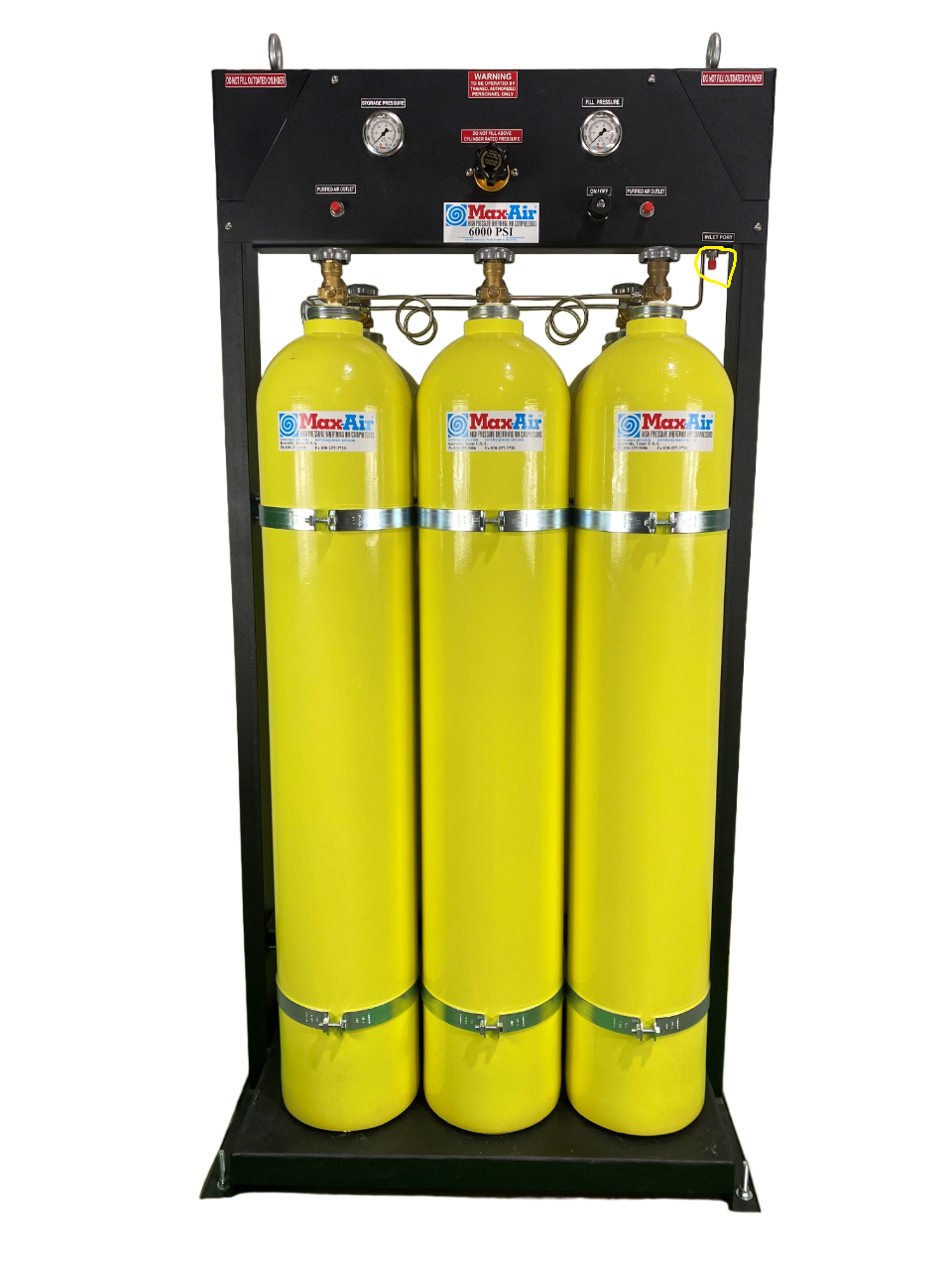
What Is a Fire Department Cascade System?
A fire department cascade system stores high-pressure breathing air in a bank of large cylinders so firefighters can refill multiple SCBA cylinders quickly without waiting for the compressor to supply every fill in real time. A complete system typically includes storage cylinders, a rack, cascade controls, high-pressure tubing, safety components, and a containment fill station or approved SCBA fill connection.
The Max-Air 6000 PSI four-cylinder breathing air storage rack is a typical example: four high-pressure cylinders mounted in a single frame to give you a deep, ready reserve. With a cascade in place, the compressor’s role shifts from “fill every bottle in real time” to “keep the banks topped off between fills.”
For departments using 6000 PSI cascade storage, the Max-Air MA90 VRT 6K can provide automatic high-pressure breathing air to replenish the cascade banks between SCBA fills.
How Does a Fire Department Cascade System Work?
A fire department cascade system transfers stored breathing air from a series of high-pressure storage cylinders into lower-pressure SCBA cylinders. Air is drawn from the storage bank with the lowest usable pressure first, then from progressively higher-pressure banks until the SCBA cylinder reaches its required fill pressure.
The efficiency comes from staging the fill across banks in ascending order:
- Open the lowest-pressure bank first to bring the empty cylinder partway up.
- Switch to a mid-pressure bank to push it higher.
- Finish, or “top off,” with the highest-pressure bank to reach the target fill pressure.
This matters because a receiving cylinder can only fill to just under the pressure of the bank feeding it. Staging from low to high lets you pull a much larger share of stored air from each bank before the compressor needs to run, and you still reach a complete fill as long as the final bank sits above your target pressure.
A manual cascade fill panel lets the operator open and close each bank by hand. An auto cascade panel sequences the banks automatically as pressures equalize, reducing operator workload and error on busy days. Check valves prevent air from flowing backward between banks, and the fill panel still lets you fill directly from the compressor whenever you choose.
Fire Department Cascade System vs. Direct Compressor Filling
Direct compressor filling sends breathing air from the running compressor directly to an SCBA cylinder or containment fill station. This can work well when filling demand is predictable and there is enough time between cylinder fills.
A fire department cascade system fills SCBA cylinders from pre-charged storage banks. This provides faster turnaround when several cylinders must be refilled after an incident, while the compressor recharges the storage banks between periods of heavy demand.
Why Fire Departments Use Cascade Systems for High-Demand SCBA Filling
After a structure fire or training exercise, a department may need to refill several SCBA cylinders within a short period. Filling every cylinder directly from the compressor can create delays because the compressor must generate the air for each fill in real time.
A properly sized cascade system provides a reserve of stored breathing air for faster back-to-back cylinder filling. The compressor can then recharge the storage banks between incidents or periods of heavy use.
- Speed. Stored air transfers into a cylinder in minutes because it’s just pressure equalizing. Filling the same SCBA bottle directly from a compressor can take 20 minutes or more each. With a charged cascade, a line of waiting tanks gets turned around far faster.
- Less compressor wear. Every fill drawn from the bank is one the compressor didn’t run for. Start-up is the hardest moment in a compressor’s life, because oil hasn’t fully circulated yet. Direct filling starts the compressor for nearly every bottle; a cascade gives you many fills between starts.
- Heat and duty cycle. A cascade lets the compressor recharge during downtime — early morning, after hours, between rushes — instead of being run hard while customers wait. Less heat means better longevity and better air quality.
- Surge and reserve capacity. A charged cascade is a buffer for your busiest moments: the morning a dive boat needs ten tanks at once, or the call where a fire department must put a stack of SCBA bottles back in service immediately. The air is already made and waiting.
- A measure of backup. If power drops, a compressor stops, but a charged cascade still holds usable air.
Does Your Department Need a Fire Department Cascade System?
A fire department cascade system is most useful when several SCBA cylinders must be refilled within a short period, when rapid turnaround is important, or when the department needs a reserve of stored breathing air. Direct compressor filling may still be adequate for a smaller department with low filling demand and enough recovery time between cylinders.
Signs your department may benefit from cascade storage:
• Multiple SCBA cylinders are routinely filled back-to-back.
• Peak filling demand occurs after incidents, training exercises, or mutual-aid responses.
• Firefighters cannot wait for the compressor to produce every fill in real time.
• The department needs stored breathing air during periods of heavy demand or compressor downtime.
• The filling system includes a containment fill station, mobile air apparatus, or other high-volume equipment.
Direct compressor filling may be sufficient when:
• Only a small number of SCBA cylinders are filled each day.
• Cylinders are rarely filled back-to-back.
• The compressor has enough time to recover between fills.
• Fast emergency batch filling is not required.
The final decision should be based on the department’s busiest-hour filling demand, SCBA cylinder pressure and capacity, compressor output, desired turnaround time, available space, and budget.
What Compressor Does a Fire Department Cascade System Need?
A fire department cascade system needs a breathing-air compressor sized to recharge the storage banks within the department’s required recovery period. The correct compressor output depends on the number and size of the storage cylinders, storage pressure, peak SCBA filling demand, available electrical service, and how quickly the system must be ready for the next incident.
A 5,000 psi compressor may be appropriate for many standard SCBA filling systems, while a 6,000 psi compressor is required when charging compatible 6,000 psi cascade storage. Higher-volume departments may need increased compressor output, additional storage, or redundant compressor capacity. Max-Air should review the complete system before final equipment selection.
Frequently Asked Questions
How Many Storage Cylinders Does a Fire Department Cascade System Need?
The correct number depends on the size and pressure of the department’s SCBA cylinders, the maximum number filled during the busiest hour, storage-bank pressure, compressor output, and the required turnaround time. A department with occasional filling may need less storage than one that must refill many cylinders immediately after an incident. Max-Air should review the complete filling demand before recommending the number and size of storage cylinders.
What Pressure Should a Fire Department Cascade System Use?
Cascade storage systems may operate at 4,500, 5,000, or 6,000 psi, depending on the SCBA cylinders, compressor, fill station, and storage configuration. Higher storage pressure can provide more usable reserve air, but every component must be rated for the selected working pressure. The compressor and storage-bank pressure should be matched as a complete system.
Can SCBA Cylinders Be Filled Directly From the Compressor?
Yes. Many systems allow SCBA cylinders to be filled directly from the compressor when demand is low. Cascade storage provides an additional source of pre-compressed breathing air for faster back-to-back filling during busy periods. The best configuration may provide both direct-compressor filling and cascade filling.
What Is the Difference Between Manual and Automatic Cascade Controls?
With a manual cascade system, the operator opens and closes each storage bank in sequence. An automatic cascade system controls the sequence as pressures change, which can simplify operation and reduce the amount of manual valve control required. The correct choice depends on filling volume, staffing, budget, and the department’s preferred operating procedure.
What Equipment Is Included in a Fire Department Cascade System?
A complete fire department cascade system may include high-pressure storage cylinders, a storage rack, cascade controls, high-pressure tubing, valves, gauges, safety components, a breathing-air compressor, purification equipment, and a containment fill station. The exact equipment depends on the department’s SCBA cylinders, available space, electrical service, and filling demand.
Does Max-Air Provide Complete Fire Department Cascade Systems?
Yes. Max-Air can help configure the breathing-air compressor, storage cylinders, cascade controls, purification equipment, and fill station as a complete system. Final selection should be based on the department’s cylinder pressure and capacity, busiest-hour filling demand, available utilities, installation space, and desired recovery time.
Talk Through Your Setup With Max-Air
If you’re on the fence, tell Max-Air how many bottles you fill, what pressures you run, and how fast you need them turned around, and the team will help you determine whether a cascade makes sense — and which storage and compressor pairing fits your operation. Max-Air has built and supported high-pressure breathing air systems from Kerrville, Texas for decades and would rather point you to the right setup than sell you more than you need.
Call Max-Air at (830) 257-5006, or reach out through max-air.com to talk it through.